
Change is the only constant in life, impacting both our personal and professional circles. individuals and organizations capable of adeptly navigating these transformations tend to thrive. from technological advancements and shifts in market trends to personal life events. The ability to adapt is a vital skill that empowers individuals and organizations not only to survive but also to excel in the face of uncertainty.
The importance of resilience (flexibility) in the workplace cannot be overstated. It is not just about weathering storms; it is about succeeding among the constant winds of change. Resilience allows individuals to adapt their mindset and approach when faced with challenges or unexpected circumstances. It enables them to bounce back from setbacks, learn from failures, and find new opportunities for growth.
Moreover, resilient employees are better equipped to handle stress and uncertainty effectively. They can maintain a positive attitude even during difficult times, inspiring those around them with their firm determination and optimism.
Organizations that prioritize resilience within their workforce benefit in multiple ways. Resilient employees are more likely to stay motivated and engaged despite ongoing changes or disruptions. They bring an innovative perspective to problem-solving and readily embrace new ideas that drive productivity and success.
By fostering a culture of resilience, companies create an environment where individuals feel supported through difficulties rather than overwhelmed by them. This ultimately leads to higher employee satisfaction levels, increased retention rates, and improved overall performance.
The Power of Adaptation in Business: Real-World Examples
Adaptation is a must in the corporate world. Those who fail to adapt may find themselves falling behind, while those who embrace change and innovation can secure their future success. Adaptation is not merely a survival strategy; it's a path towards thriving and excelling in an ever-changing world of business and technology. As we’ve seen with Nokia's lost chance, disastrous outcomes may result from a lack of adaptability. On the other hand, as shown by Amazon, IBM, and Netflix, a corporation may achieve success by adaptability. Here we'll look at several real-life examples that show how important adaptability is for businesses.
Nokia's Missed Opportunity
Nokia, once a global mobile phone giant, shows what happens when people resist change. In the early 2000s, Nokia was unmatched. However, they failed to foresee the ascent of smartphones and the revolutionary touch-screen technology. Even though they had the ability to innovate, Nokia stuck with its old mobile phone designs for a long time, which caused their market share to drop significantly.
Netflix's Transformation
In contrast, Netflix presents a remarkable story of adaptation and transformation. Initially, Netflix operated as a DVD rental service. Their quick shift towards internet streaming, original content production, and trouble of the existing cable TV sector was a response to the changing media consumption environment. Netflix became an international entertainment giant by adopting the digital age and responding to consumer tastes.
IBM's Reinvention
Despite being one of the oldest technological businesses in the world, IBM had a rough go of it in the latter part of the twentieth century. Their major business was seriously jeopardized by the shift from mainframe computers to personal computers. The fact that IBM was able to turn into a consulting and solutions business shows how flexible the corporation is. Because of this shift in strategy, IBM was able to prosper in the information era.
Amazon's Innovation Culture
The significance of constant innovation was immediately obvious to Jeff Bezos, Amazon's founder. As part of Amazon's business culture, Bezos promoted an atmosphere that valued trying new things and taking calculated risks. So, in response to the e-commerce boom, Amazon moved into other industries, such as smart gadgets (Amazon Echo), cloud computing (Amazon Web Services), and more. They have become market leaders in several sectors thanks to their relentless efforts at innovation and adaptation.
Promoting Workplace Resilience
Establishing a workplace environment that nurtures resilience is crucial for the well-being of employees. When workers feel supported, valued, and genuinely cared for, they are better equipped to navigate and adapt to the challenges of change. To foster this kind of resilience, consider implementing the following strategies within your organization:
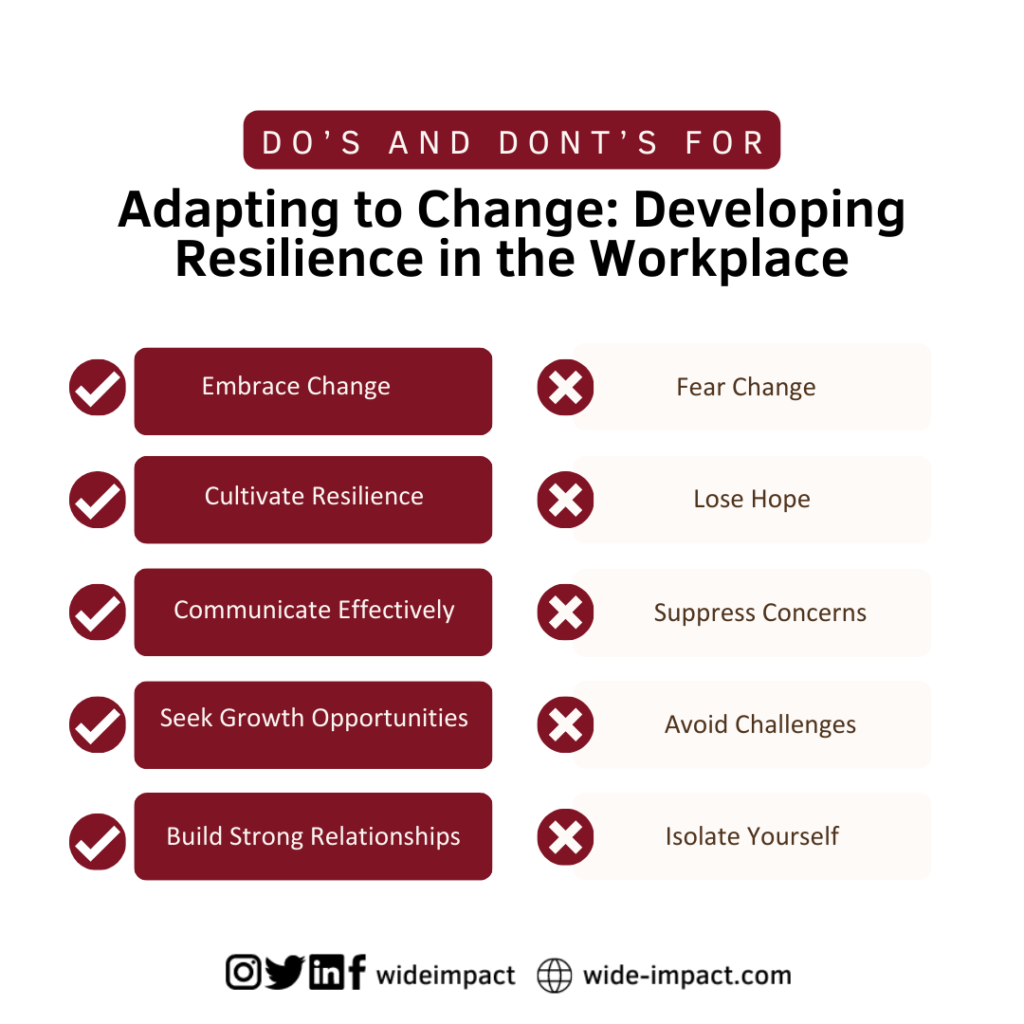
Change is unavoidable in the workplace and it can often be difficult to adapt. However, by developing resilience, we are able to bounce back from challenges and use them as opportunities for growth. Through the tips mentioned above, we not only improve our performance in the workplace, but also enhance our overall well-being. Let us remember that change is constant and by developing resilience skills, we can cross through any challenges that come our way with confidence and success. Remember that building resilience takes time and effort but the benefits of being able to adapt to change are well worth it. So let us welcome change with open arms and continue growing both personally and professionally through resilience.